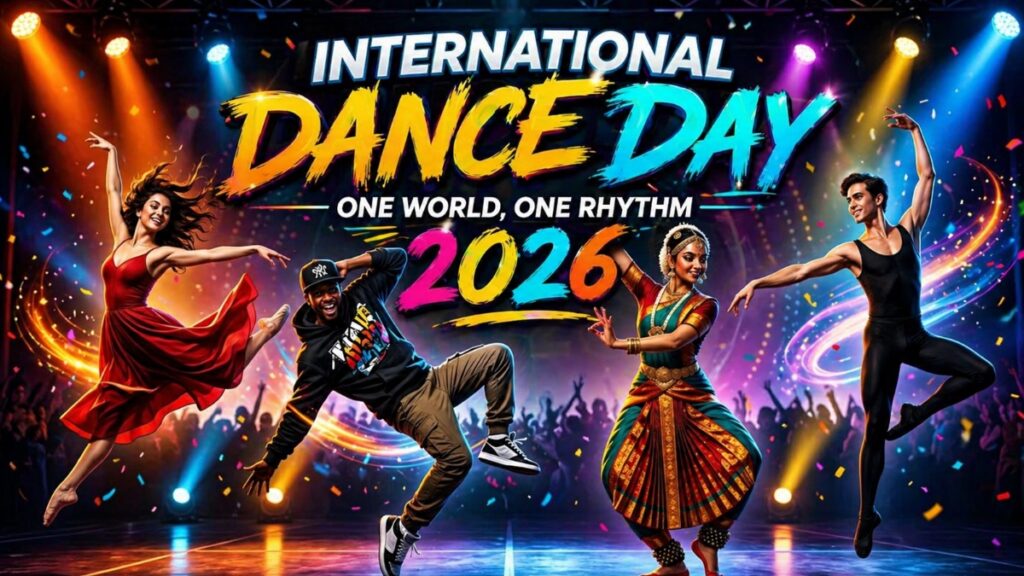
Every year on April 29, the world unites to celebrate International Dance Day 2026 — a globally recognized occasion dedicated to honoring one of humanity’s most powerful forms of expression. This year, International Dance Day 2026 carries special significance for Indian cinema lovers, as some of Bollywood’s most legendary choreographers are raising a deeply important question: Is Hindi cinema slowly losing its love for dance?
On International Dance Day 2026, three iconic names in Bollywood choreography — Vaibhavi Merchant, Chinni Prakash, and Vijay Ganguly — have shared their candid thoughts about how dance in Hindi films has evolved over the decades, what precious things have been lost along the way, and what still gives them hope for the future of Indian film dance.
What Is International Dance Day 2026?
International Dance Day 2026 is celebrated every year on April 29 — the birthday of Jean-Georges Noverre, widely regarded as the creator of modern ballet. This important day is recognized and supported by UNESCO and is celebrated across the globe through live performances, workshops, school events, and deep conversations about the power and meaning of dance in human life.
International Dance Day 2026 is not just a celebration — it is also a moment of reflection. It is a day when the dance community around the world asks: Where have we come from? Where are we going? And what must we protect along the way? International Dance Day — Wikipedia
In India, this question feels especially urgent. Dance has always been far more than entertainment here. From ancient classical forms like Bharatanatyam, Kathak, Odissi, and Manipuri to the high-energy, globally loved Bollywood numbers that have defined entire generations — dance is woven deeply into the fabric of Indian culture and identity.
But on International Dance Day 2026, the conversation in Bollywood is more complex and more urgent than ever before. The rise of social media, short-form video reels, and rapidly changing audience habits have fundamentally altered how dance is created, performed, and consumed in Hindi cinema. And not everyone is happy with the direction things are heading.
Vaibhavi Merchant: “Retaining the Soul of the Song Is Important”
When we talk about International Dance Day 2026 and Bollywood choreography, the name Vaibhavi Merchant stands at the very top of the conversation. She is one of the most celebrated and respected choreographers working in Hindi cinema today, with multiple National Awards to her name.
Karuppu Movie Review: Suriya and RJ Balaji’s Bold Cinema
Her choreography for “Dholi Taaro Dhol Baaje” in Hum Dil De Chuke Sanam (1999) and “Dhindora Baaje Re” in Rocky Aur Rani Kii Prem Kahaani (2023) are considered absolute masterpieces of Indian film choreography — sequences that will be remembered and studied for generations to come.
On this International Dance Day 2026, Vaibhavi turns her gaze toward the timeless classics that continue to inspire and guide her work. She considers songs from Guide (1965), Pakeezah (1972), and Jewel Thief (1965) as the true gold standard of choreographic excellence in Indian cinema. Growing up watching the work of her grandfather B Hiralalji and the legendary B Sohanlalji — who was the mentor of the great Sarojji — Vaibhavi developed an unshakeable appreciation for the depth, grace, and artistry of classic Indian film dance.
For her, the legendary dance competition between Padmini and Vyjayanthimala in Raj Tilak (1958) remains her all-time favorite sequence in the history of Indian cinema. It is a powerful reminder that truly great choreography is never about spectacle alone — it is about emotion, authentic storytelling, and extraordinary technical mastery working together in perfect harmony.
Vaibhavi also acknowledges the positive side of today’s Bollywood landscape. Directors like Karan Johar, Aditya Chopra, Raju Hirani, and SS Rajamouli invest heavily in song sequences, shooting them on a grand scale with the kind of massive budgets that allow choreographers to fully realize their creative visions. Having dedicated financial support for songs, she says, makes an enormous difference to the final product.
However, she is also honest about a growing trend that she personally finds uninspiring. The idea of simply flying to a foreign location with foreign dancers and calling it a song sequence no longer excites her at all. For Vaibhavi, the soul of a song will always matter more than its visual scale or its passport stamps. Every song must fit organically and naturally into the film’s narrative — it must serve the story, not exist as a disconnected visual spectacle designed primarily for the trailer.
As International Dance Day 2026 arrives, Vaibhavi is channeling these values into her new project — a film called Eetha, where she is deeply exploring the Lavani dance form, a rich and vibrant classical dance tradition from Maharashtra. This commitment to rooting grand commercial cinema in authentic Indian dance traditions is her gift to the industry on International Dance Day 2026
Chinni Prakash: “I’m Afraid Dance Will Be Limited to Reels”
No conversation about International Dance Day 2026 and Bollywood would be complete without the voice of Chinni Prakash — one of the most decorated and respected figures in the entire history of Indian film choreography.
Chinni Prakash won the prestigious National Film Award for his extraordinary choreography of “Azeem-O-Shaan Shahenshah” in Jodhaa Akbar (2008) — a sequence that stands as one of the most visually stunning and emotionally powerful song picturizations in the history of modern Bollywood.
On International Dance Day 2026, his message is one of genuine concern — a warning from the heart of someone who has spent his entire life in service of dance. He believes that the pace of change sweeping through the dance world today has become truly overwhelming — not just for audiences trying to keep up, but for the choreographers and dancers who are trying to do their best work.
Chinni Prakash looks back at the 1980s and 1990s — the golden years of his active career — with a mixture of nostalgia and respect. In those decades, a major new dance style would emerge approximately every 10 years. That slower rhythm gave choreographers and dancers the precious gift of time — time to fully learn a style, to master its nuances, to explore its possibilities, and to push its boundaries before the next wave arrived. The work that came out of that environment was deeper, richer, and more fully realized.
Today, on International Dance Day 2026, that rhythm has been shattered. In a single year, the industry is now confronted with 10 or more new dance styles — each one driven by global social media trends, viral videos, international pop culture, and cross-cultural influences moving at the speed of the internet. By the time a dedicated dancer has even learned the basics of one style, it has already been replaced by something newer and flashier.
He also highlights a deep structural problem in contemporary Bollywood that becomes painfully obvious when you celebrate International Dance Day 2026 and think about what dance in Hindi cinema used to mean. Even in Dhurandhar 2 — a four-hour epic — genuine, meaningful dance sequences are barely present. Compare this to his own work on Prem Loka (1987) featuring the wonderful Juhi Chawla, where the film featured 10 full songs shot beautifully in two different languages. In those days, dance was not an afterthought — it was the beating heart of the film.
What troubles Chinni Prakash most deeply on this International Dance Day 2026 is the disappearance of the wedding song — those joyful, foot-tapping, celebratory numbers that entire families would perform together at weddings and gatherings for decades after a film released. Those songs were living cultural artifacts. Today, they have all but vanished from Bollywood.
“I’m afraid that in the coming times there won’t be any dance in films — it will only be limited to reels.” On International Dance Day 2026, these words from a true master of the craft carry the weight of both sadness and warning.
Vijay Ganguly: “Telling the Story Authentically Through Songs Is the Only Way”
Rounding out this powerful International Dance Day 2026 conversation is choreographer Vijay Ganguly, who brings a deeply thoughtful and technically informed perspective to the debate about where Bollywood dance stands today and where it needs to go.
Ganguly focuses on something that is often overlooked in these discussions — the way that fundamental changes in filmmaking technology have silently but profoundly changed the way dance is captured and experienced on screen.
In the classic era of Hindi cinema, every film was shot on physical film rolls. These rolls were expensive, and each shooting day came with a strictly limited amount of stock. This financial constraint created an invaluable creative discipline. The great Sarojji — one of the towering legends of Indian film choreography — would meticulously plan every single shot before it was filmed. Every angle, every duration, every moment of the dance was mapped out precisely on paper before the cameras rolled.
The actors of that era were trained accordingly — to hold the frame, to sustain a complete and nuanced performance within a single longer take. The result, visible in International Dance Day 2026 retrospectives and classic film screenings everywhere, is that audiences could fully see and feel everything: the actor’s precise expression, their natural grace, their tehrav (the art of meaningful stillness), and their ada (personal style and charm). These qualities became the living soul of Bollywood’s greatest song performances.
Digital filmmaking, which International Dance Day 2026 finds now completely dominant in the industry, has changed this in ways both positive and problematic. On the positive side, entire songs can be shot in a single session, mistakes corrected instantly, and footage reviewed immediately. But the hidden cost is what Ganguly calls editing culture — because digital footage is cheap and plentiful, song sequences are now cut aggressively, switching camera angles every two or three seconds, never allowing a single moment of performance to breathe or land fully with the viewer.
What disappears in that cutting is precisely what made classic Bollywood songs so deeply memorable — the sustained expression, the tehrav, the ada. These are qualities that only register in longer, unbroken shots. In a sequence that cuts every few seconds, they become invisible.
As International Dance Day 2026 is observed around the world, Ganguly is doing something about this personally — actively working to bring back the culture of longer shots in his choreography. And his solution to the broader challenge of competing with an audience drowning in dance content from every direction is elegant and timeless: tell the story authentically through the song. Find the moments in the narrative that can live inside the music. Make the song inseparable from the film it belongs to.
When a song does that successfully, no Reel — however technically impressive — can touch it.
The Bigger Picture: 5 Forces Reshaping Bollywood Dance in 2026
As we observe International Dance Day 2026, it is worth stepping back to understand the larger forces that are reshaping how dance exists in Hindi cinema:
1. The Dominance of Short-Form Content
Social media has rewired audience attention. A 5-minute song sequence now requires a level of patience that casual viewers simply no longer offer. Filmmakers respond by shortening and simplifying sequences to suit shortened attention spans.
2. Unstoppable Global Influences
Bollywood dance has always evolved by borrowing from global trends. But in 2026, the rate of that borrowing is so fast that no single style has time to develop roots, meaning, or cultural depth before it is replaced.
3. Songs Disconnected From Story
Classic Hindi cinema built songs into the heart of the narrative. Today, many films treat songs purely as promotional content — shot separately, released early, designed for YouTube rather than the cinema. The emotional connection between song and story is broken.
4. Unequal Budget Distribution
Grand dance sequences are now primarily the privilege of the biggest productions. Mid-budget and smaller films simply cannot afford the kind of choreographic investment that once made Bollywood dance a democratic art form enjoyed across all budget levels.
5. The Reel Economy
Perhaps most significantly for International Dance Day 2026 — dance is increasingly being produced and consumed through social media reels. This is not entirely negative, but it does mean that the skills, artistry, and depth that define great choreography are being subordinated to whatever works in 30 seconds.
Frequently Asked Questions About International Dance Day 2026
Q1. When is International Dance Day 2026 celebrated?
International Dance Day 2026 is celebrated on April 29, 2026. This date marks the birthday of Jean-Georges Noverre, the father of modern ballet, and has been recognized as International Dance Day by UNESCO since 1982.
Q2. What is the theme of International Dance Day 2026?
The theme of International Dance Day 2026 centers around the preservation of cultural dance traditions while embracing the evolution of contemporary dance forms. In India, this theme resonates deeply with ongoing conversations about Bollywood choreography and the future of dance in Hindi cinema.
Q3. Who are the most famous Bollywood choreographers speaking on International Dance Day 2026?
On International Dance Day 2026, three legendary choreographers have shared their perspectives — Vaibhavi Merchant, who has won National Awards for films like Rocky Aur Rani Kii Prem Kahaani; Chinni Prakash, National Award winner for Jodhaa Akbar; and Vijay Ganguly, known for his work in bringing authentic storytelling to Bollywood song sequences.
Q4. Why is Chinni Prakash worried about the future of dance in Bollywood?
On International Dance Day 2026, Chinni Prakash expressed concern that the rapid pace of changing dance trends — driven by social media — is making it impossible for choreographers and dancers to master any single style. He fears that dance in films will eventually be reduced to short social media reels rather than full, meaningful song sequences.
Q5. What does Vaibhavi Merchant believe is most important in choreography today?
As shared on International Dance Day 2026, Vaibhavi Merchant believes that retaining the soul of the song is the most important principle in choreography. She emphasizes that a song must serve the film’s narrative rather than existing as a standalone visual product, and she actively works to preserve India’s classical regional dance forms in mainstream cinema.
Q6. How has digital filmmaking changed Bollywood dance according to Vijay Ganguly?
Vijay Ganguly, speaking on International Dance Day 2026, explained that while digital filmmaking has made shooting easier, aggressive editing culture has eliminated the longer, sustained performance shots that once defined Bollywood’s greatest dance sequences. The tehrav and ada of actors — visible only in longer uncut shots — have been lost to rapid cutting.
Q7. What is Vaibhavi Merchant’s current project in 2026?
As of International Dance Day 2026, Vaibhavi Merchant is working on a film called Eetha, in which she is exploring the Lavani dance form — a classical and vibrant dance tradition from Maharashtra, India.
Conclusion: International Dance Day 2026 and the Soul of Bollywood Dance
International Dance Day 2026 arrives at a genuinely critical crossroads for Hindi cinema. The industry must choose between the comfortable convenience of the digital age and the hard, disciplined work of preserving what made Bollywood dance one of the greatest popular art forms the world has ever seen.
The voices of Vaibhavi Merchant, Chinni Prakash, and Vijay Ganguly on International Dance Day 2026 are not voices of despair — they are voices of love. Love for an art form that has given joy, meaning, and identity to hundreds of millions of people across generations.
Dance in Hindi cinema is not merely entertainment. It is cultural memory. It is the way an entire civilization has expressed its joys, its sorrows, its celebrations, and its dreams. Losing it to the algorithm — to the 30-second reel, to the promotional music video, to the aggressively cut visual spectacle — would be a loss that no viral trend could compensate for.
On International Dance Day 2026, the hope is simple but profound: that Bollywood remembers what it does best. That it uses dance to tell stories, express emotions, and bring people together — on the big screen, on a stage, and yes, at a wedding where everyone knows every step.
Because when a song truly moves you, the length doesn’t matter. What matters is that it stays with you — long, long after the music stops.
Happy International Dance Day 2026